Bar Graph Worksheets
Free bar graph worksheets with answer key. No login or account needed. From reading traditional bar graphs and stacked bar graphs to learning to create a bar graph, we've got you covered. A grading column and quick grade scale maker grading a breeze and a modified pages help with lower level learners or when just introducing a topic. Great for teachers or for homeschool.
Browse Sheets By Problem Type
×
Traditional Bar Graphs
Link
About these worksheets
These worksheets help students develop data literacy by reading and interpreting traditional bar graphs. Each problem set includes a bar graph with multiple categories and questions that ask students to compare values, find differences, and draw conclusions from the data. Aligned with second and third grade measurement and data standards.
2md10

- Read a bar graph with four categories and tell how many are in each bar.
- Answer “how many more” and “how many fewer” questions by comparing two bars.
- Find the total for all categories by adding the values from the bars.
- Identify which category has the most and which has the least.
3md3

- Read a bar graph with five categories and tell how many are in each category.
- Answer questions that compare two categories, like which has more or how many more.
- Find the total number of items shown by adding the values from all the bars.
About these worksheets
Students practice reading and interpreting stacked bar graphs where multiple data series are layered within each bar. Worksheets include questions about individual category values, comparisons between groups, and understanding how parts relate to the whole. These activities build on basic bar graph skills for second and third graders.
2md10

- Read a bar graph with four categories and understand what each bar stands for.
- Use the scale on the graph to find the value for each bar.
- Answer questions that compare two categories, like which has more or less and by how much.
- Add or subtract values from the graph to answer questions about totals and differences.
- Use the graph to find the highest and lowest categories.
3md3

- Read a bar graph with five categories and understand what each bar stands for.
- Use the scale on the axis to find the value of each bar.
- Answer questions that compare categories, like which is most, least, or how many more.
- Add or subtract bar values to answer questions about totals and differences.
About these worksheets
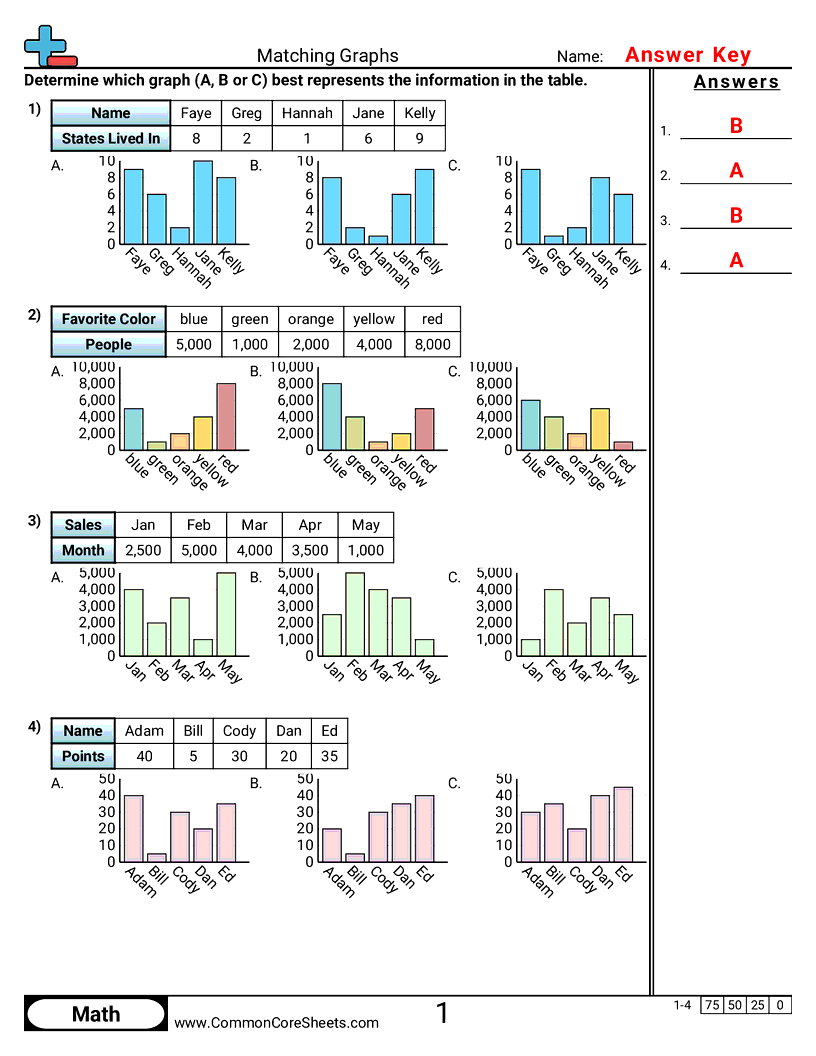
These worksheets teach students to organize raw data into charts and match data displays to the correct visual representations. Activities include creating charts from data sets, answering questions based on organized information, and matching charts to their corresponding bar graphs. Aligned with first and third grade standards.
1md4

- Sort a set of information into clear categories before making a chart.
- Fill in a chart or table by counting how many items are in each category.
- Read a chart to answer questions about which category has more, less, or the same.
- Compare two categories by finding how many more or fewer items one has than the other.
3md3

- Read a data chart and understand what each row and column means.
- Match a chart to the graph that shows the same data.
- Check that the labels, scale, and bar heights on a graph fit the numbers in the chart.
3md3

- Match a bar graph to the table of numbers that shows the same data.
- Read the labels and scale on a graph to understand what each bar stands for.
About these worksheets
Students learn to work with histograms — a key data display for grouped numerical data. Worksheets cover creating histograms from data sets by sorting values into intervals, interpreting existing histograms to answer questions about frequency and distribution, and matching data sets to the correct histogram. These resources help students understand how data can be grouped and visualized.

- Sort data into equal-sized intervals (bins) based on the number range.
- Count how many data points fall in each bin and record the frequencies.
- Draw a histogram with correctly spaced bars that match the bin counts.
- Read a histogram to describe which ranges happen most and least often.

- Read a histogram and explain what the bars and labels mean.
- Find how many data points fall in a given interval (bin).
- Identify which interval has the most or least data.
- Compare two intervals to see where values are more common.

- Read a histogram and tell how many data points fall in each interval.
- Match a list of data values to the histogram that shows the same frequency pattern.
- Compare two histograms to see which one fits a data set better based on the shape and counts.