Converting Forms Worksheets
Free converting forms worksheets with answer key. No login or account needed. From converting fractions to decimals, numeric to word and everything in between, we've got you covered. A grading column and quick grade scale maker grading a breeze and a modified pages help with lower level learners or when just introducing a topic. Great for teachers or for homeschool.
×
About these worksheets
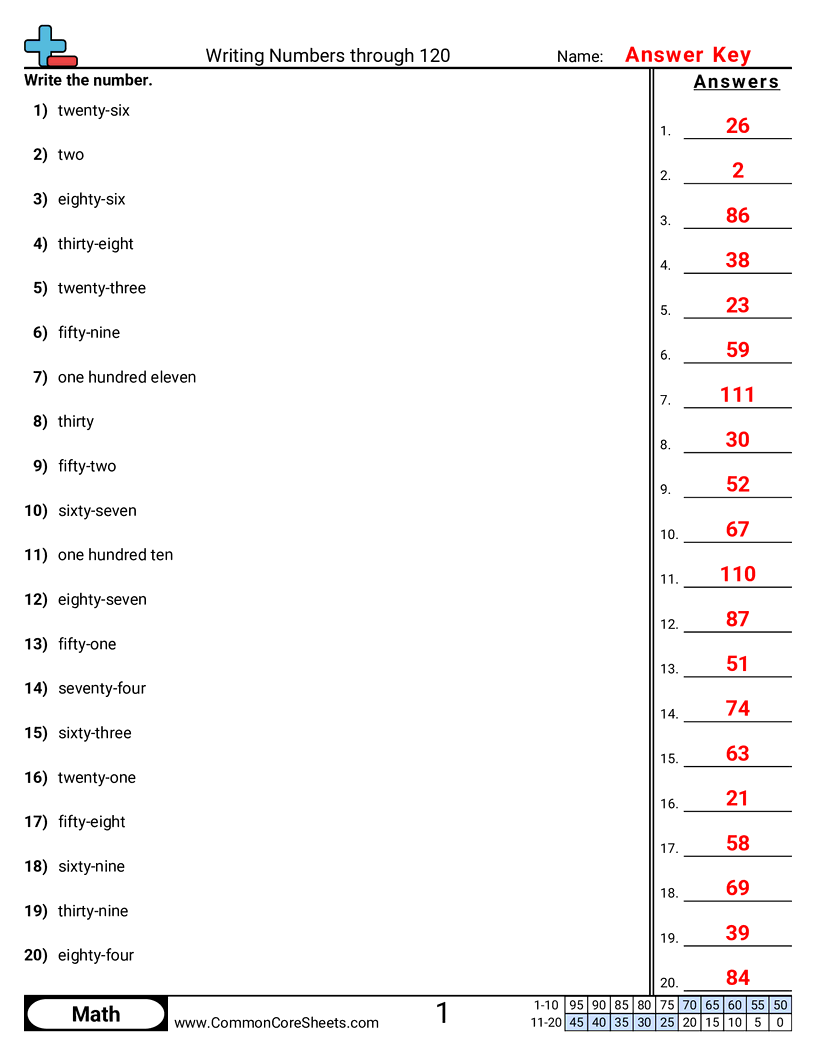
These worksheets build number sense by having students convert between word form and numeric form. Problem sets range from writing numbers through 120 for first graders up to reading and writing numbers through one million and decimals to thousandths for fourth and fifth graders. Activities also include writing numbers using tens and ones, converting between multiple forms, and writing simple equations from word form.
1nbt1
Read number words and write the matching number using digits. Tell the difference between similar-sounding number words like fourteen and forty. Recognize and write numbers from 0 to 120 in standard (numeric) form.
1nbt2c
Write a two-digit number when you are told how many tens and how many ones it has. Break a number into tens and ones to show what each digit means.
2nbt3
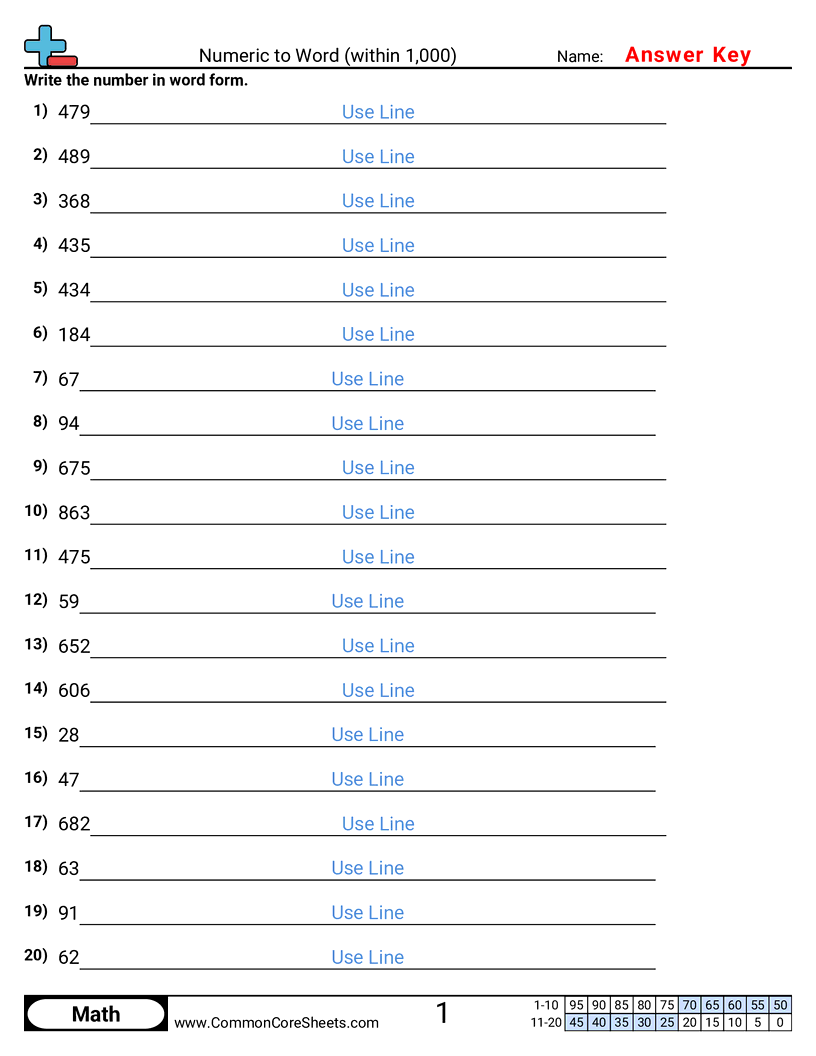
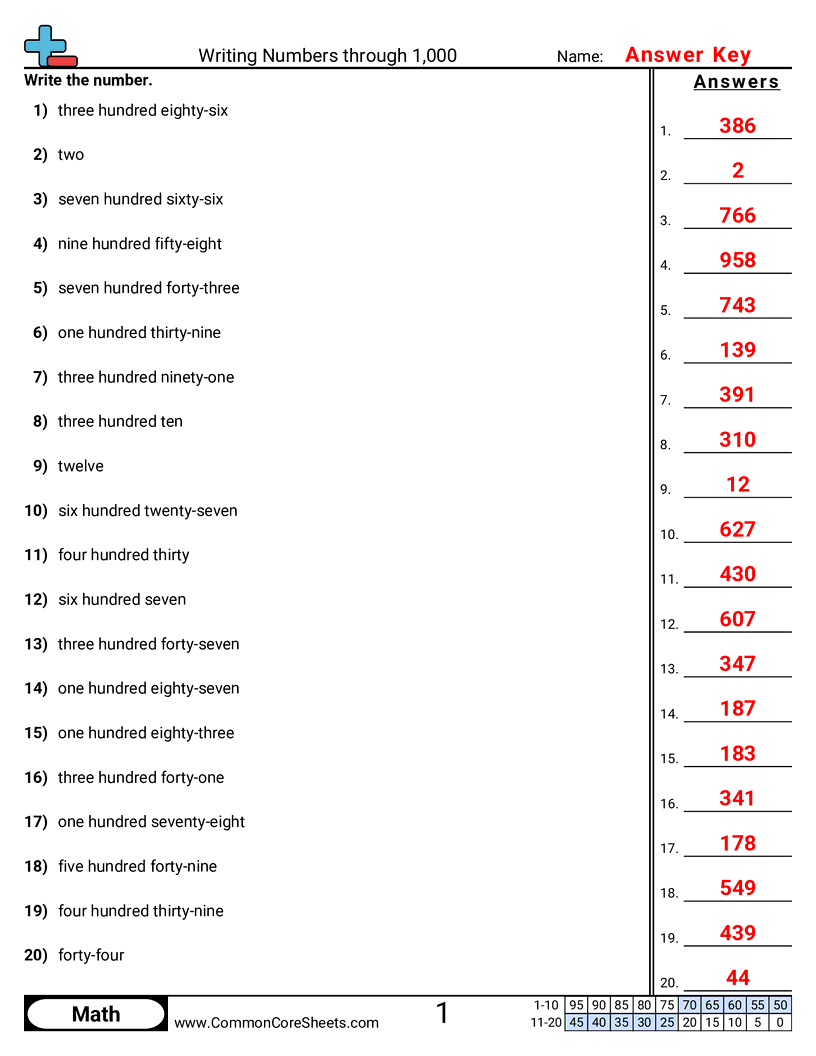
Read numbers up to 1,000 and write them out in words. Use hundreds, tens, and ones to say a number correctly in word form. Spell number words correctly, including tricky ones like the teens and multiples of ten. Write word form for numbers that have a zero in the tens or ones place.
2nbt3
Read a number written in words and write it as digits. Use place value to decide how many hundreds, tens, and ones the words describe. Handle tricky word parts like teen numbers and numbers with a zero in the tens or ones place.
4nbt2
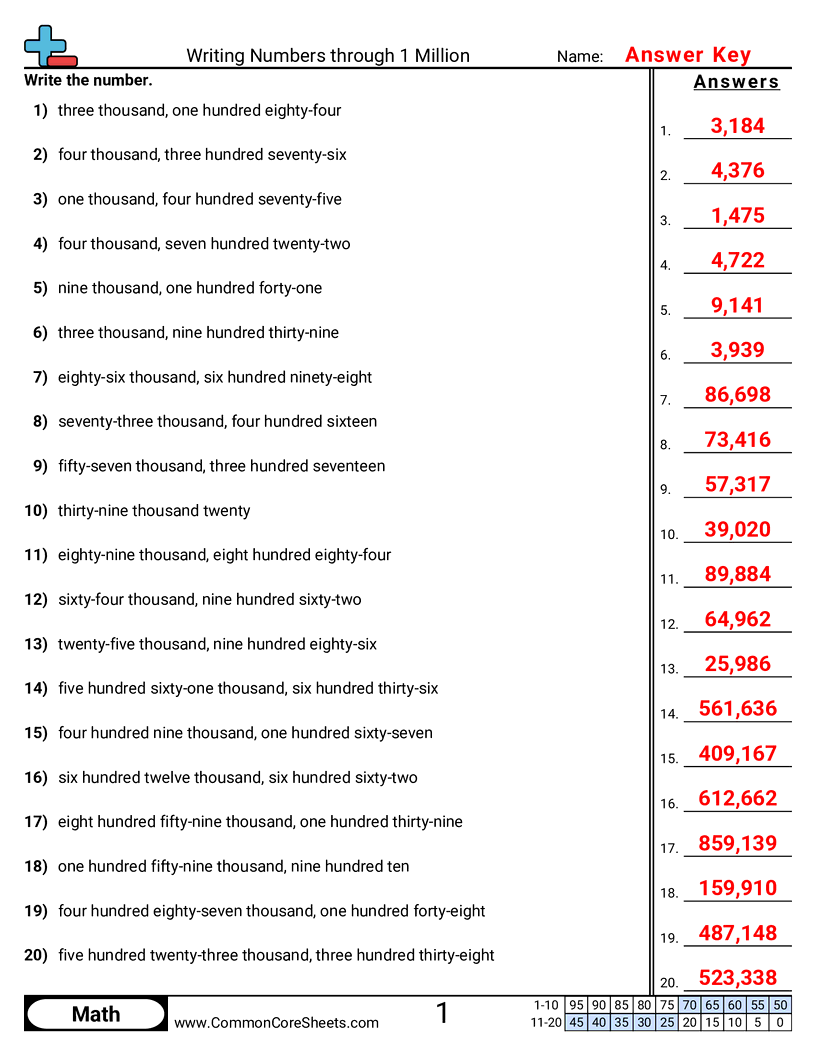
Turn a number written in words into digits correctly. Keep zeros in the right spots when a place value is skipped in the wording.
4nbt2
Read a number up to 1,000,000 and say it correctly out loud. Write a number in words using the right place-value names like thousand and hundred. Spell number words correctly and avoid common mistakes like mixing up teen and tens numbers.
5nbt3a
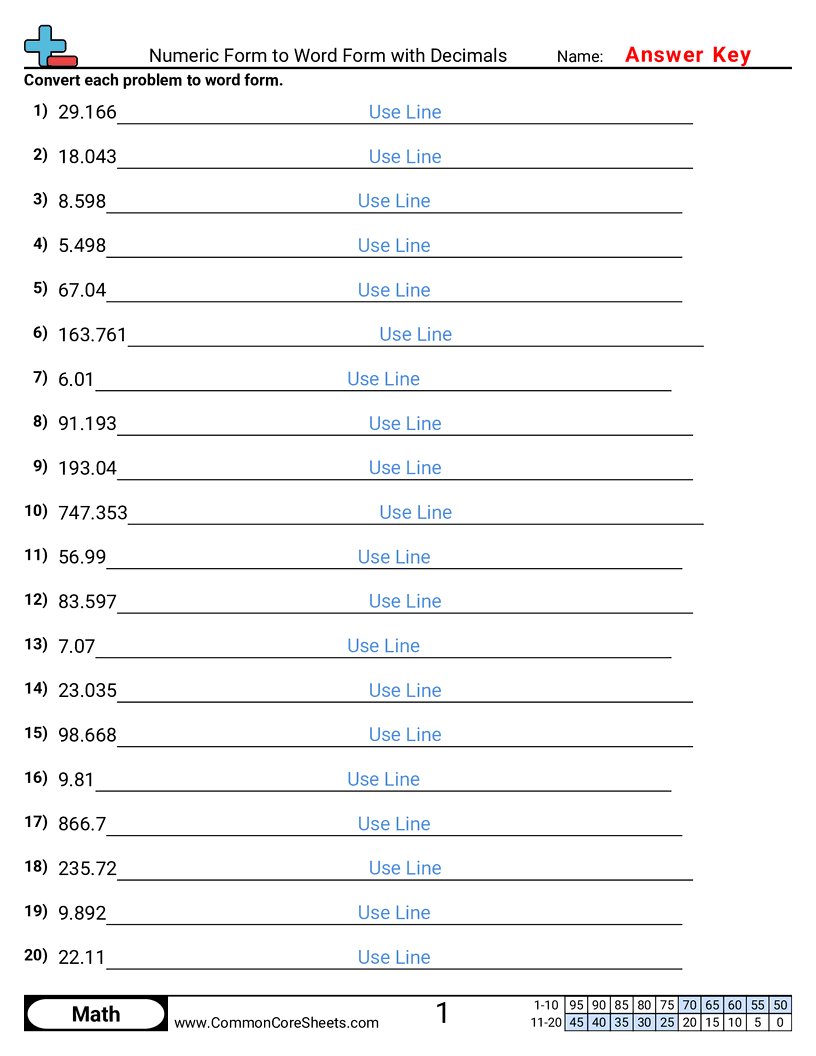
Read decimal numbers and say them correctly using place-value words like tenths, hundredths, and thousandths. Write a decimal number in word form using the word "and" for the decimal point. Spell number words correctly when writing decimals in words. Match each digit in a decimal to its correct place value so the word form says the right amount.
5nbt3a
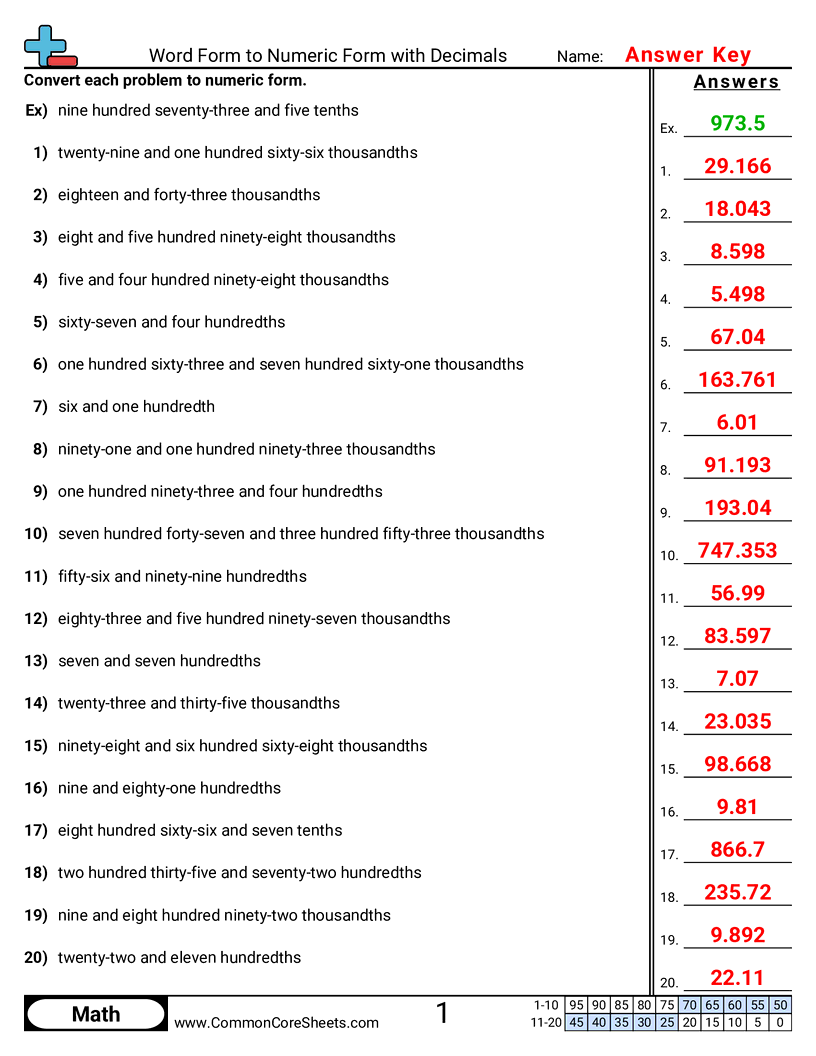
Turn a decimal written in words into the correct number with a decimal point. Use place value words like tenths, hundredths, and thousandths to decide which digits go where. Write decimals correctly when the words include zeros, like “three and five thousandths.” Read the word “and” as the decimal point when writing the number.
5nbt3a
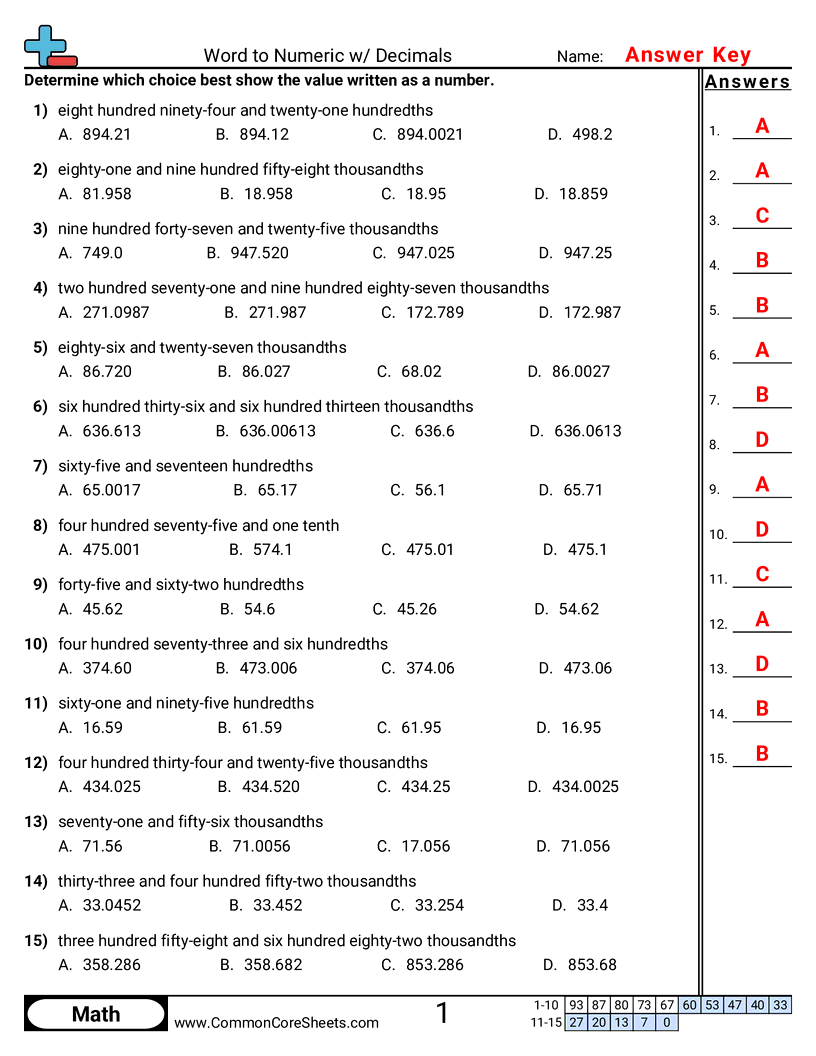
Use place value to decide which digit belongs in the ones, tenths, hundredths, and thousandths places. Translate between word form and standard numeric form for decimals. Write decimals correctly using zeros when a place value is missing.
Turn an addition or subtraction sentence into a matching equation with numbers and symbols.
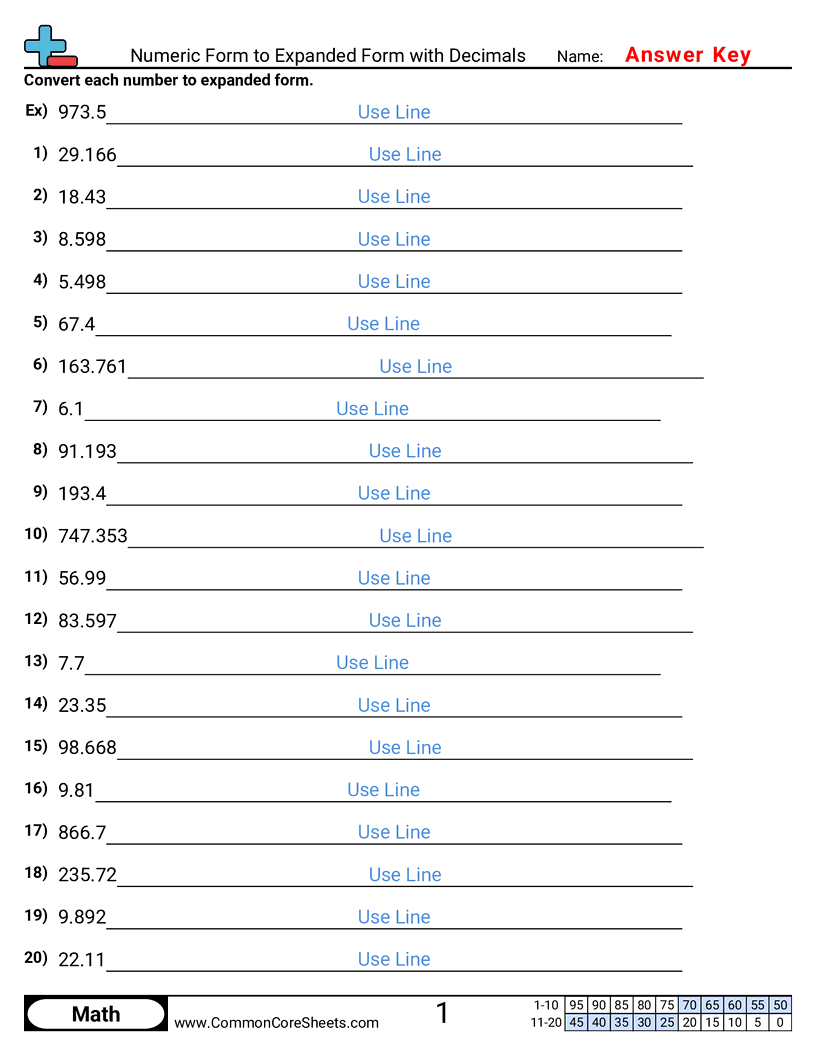
Write a number in standard (normal) form, word form, and expanded form. Switch between the three forms and recognize that they all name the same number. Use place value to break a number into the value of each digit. Read number words carefully and turn them into the correct digits.
Turn a written number into the correct word form. Use place value to decide which words to include (like hundreds and thousands). Spell number words correctly, including tricky ones like teens and multiples of ten. Write number words with the right spacing and hyphens when needed.
About these worksheets
Students practice converting numbers between expanded form and standard (numeric) form. Worksheets cover whole numbers within 1,000 up to one million, as well as decimals to thousandths. Activities include standard expanded form (like 400 + 30 + 2) and expanded notation (using multiplication by place value). These resources align with second through fifth grade place value standards.
2nbt3
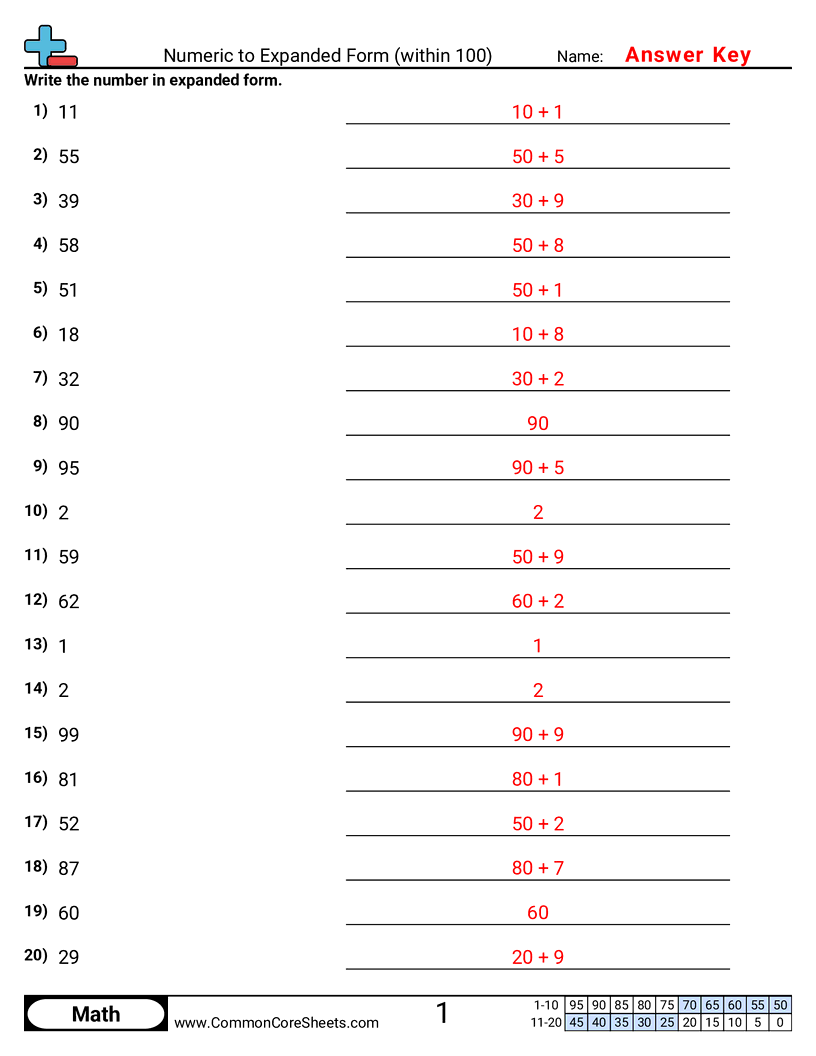
Break a two-digit number into tens and ones. Write a number in expanded form using addition (like 47 = 40 + 7). Use place value to explain what each digit in a two-digit number means. Check that the expanded form adds back to the original number.
2nbt3
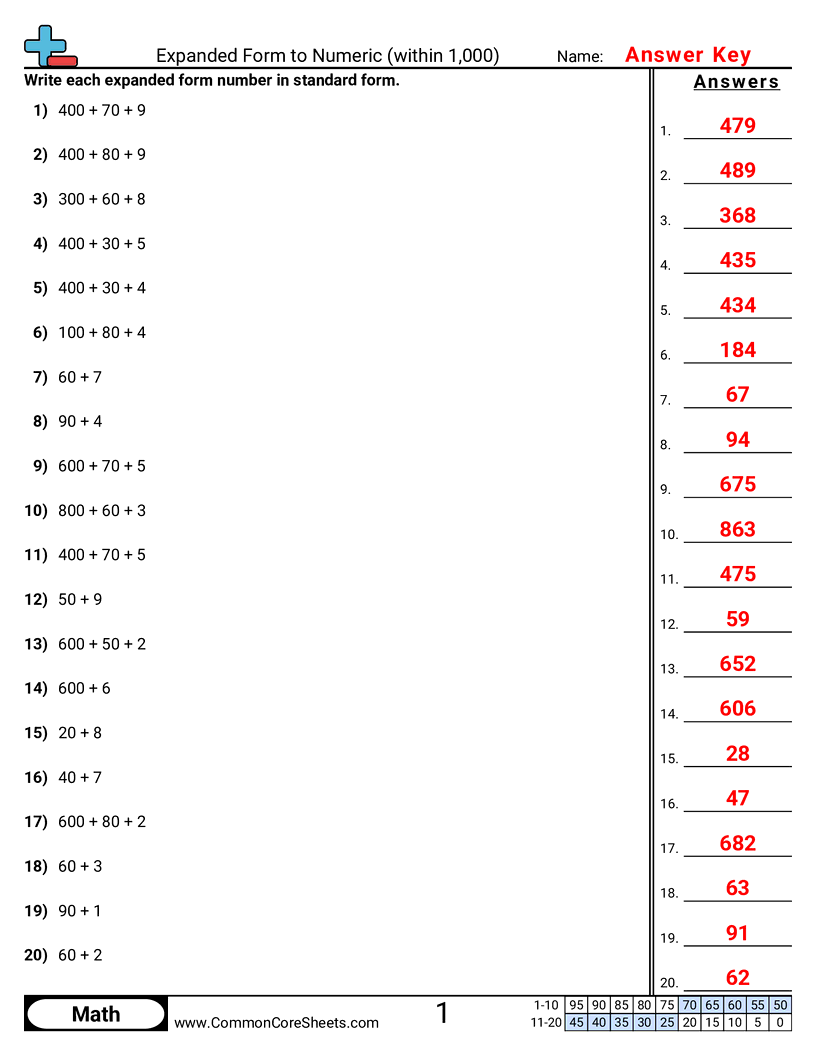
Turn an expanded form like 300 + 40 + 6 into standard form. Use hundreds, tens, and ones to understand what each part of a number means. Add the parts in expanded form to build the whole number.
2nbt3
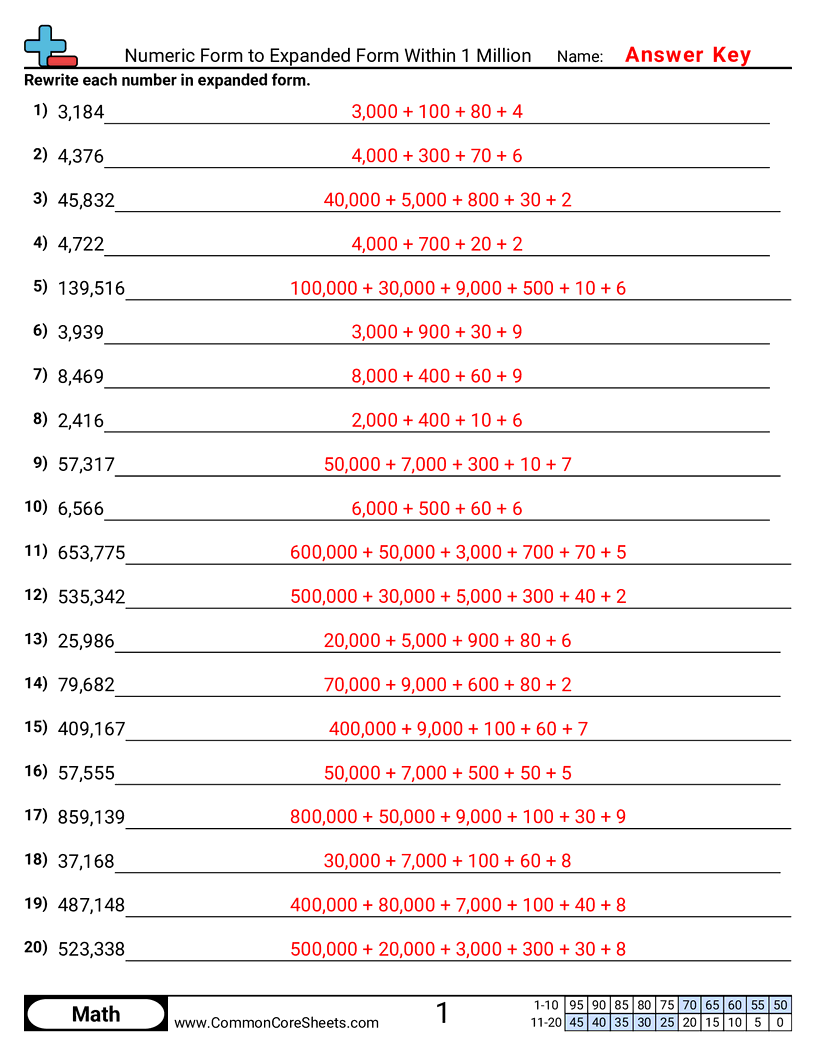
Break a number up into hundreds, tens, and ones. Write a number in expanded form as a sum (like 472 = 400 + 70 + 2). Use place value to decide which digits become hundreds, tens, and ones in the expanded form. Handle numbers that have a 0 in one place by leaving that part out or writing it as + 0.
4nbt2
Turn an expanded form like 400,000 + 30,000 + 200 + 5 into one number. Use place value to decide which digits belong in each spot from ones up to hundred-thousands. Combine the addends in expanded form to write the correct standard (numeric) form.
4nbt2
Break a number up into the value of each digit using place value. Write a number in expanded form as a sum of hundreds-thousands, ten-thousands, thousands, hundreds, tens, and ones. Use zeros as placeholders so missing place values are handled correctly in expanded form.
5nbt3a
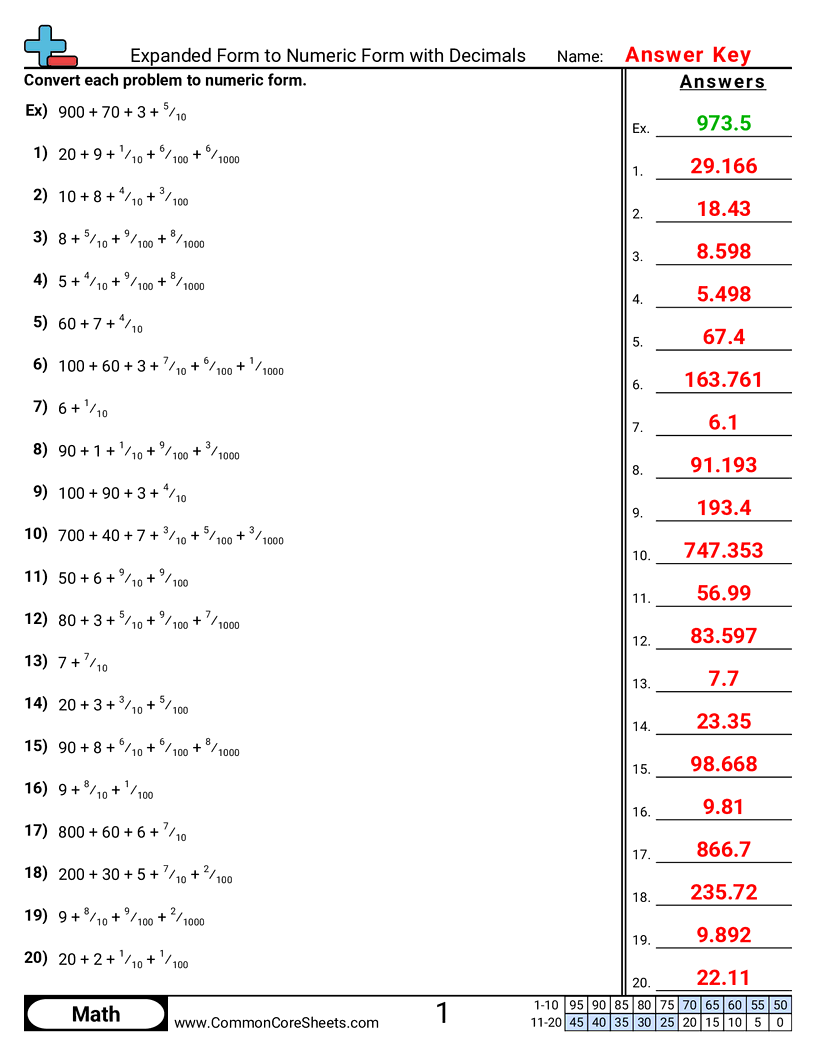
Use place value to decide which digits belong in the ones, tenths, hundredths, and thousandths places. Write decimals correctly with a decimal point and zeros when a place value is missing. Combine the parts of an expanded form by adding them to make a single decimal number.
5nbt3a
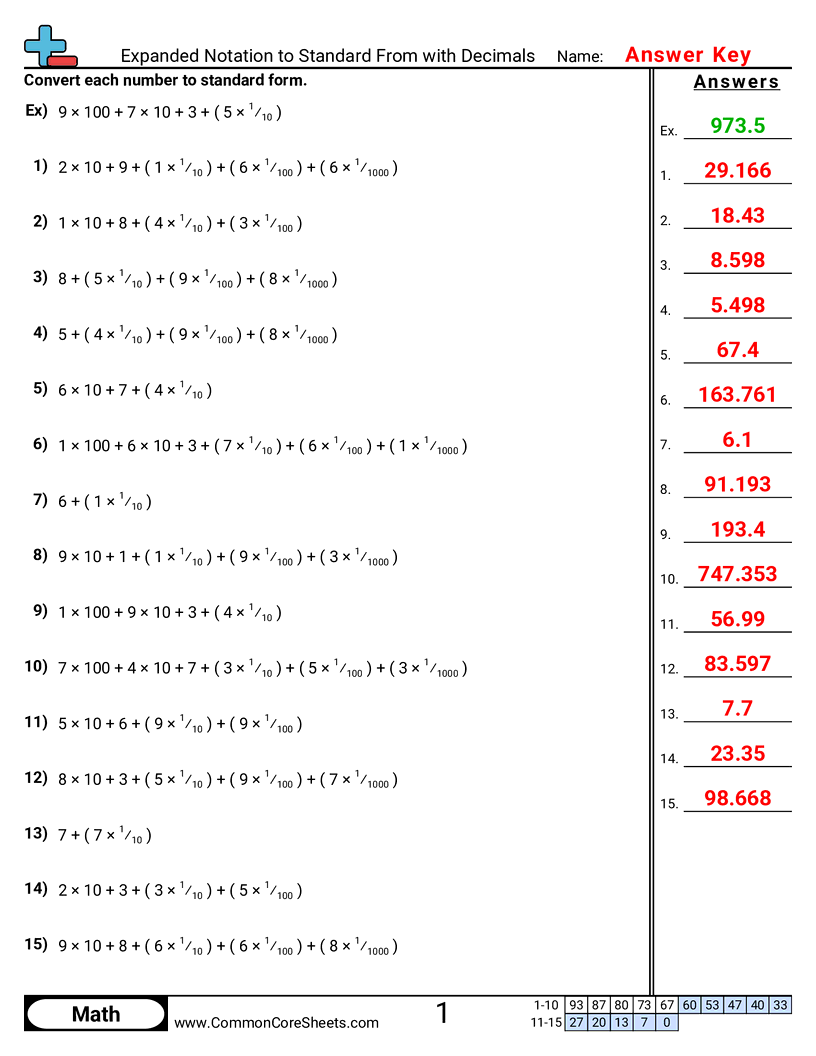
Turn an expanded notation expression into one decimal number. Use place value to decide which digits go in the ones, tenths, hundredths, and thousandths places. Combine whole-number parts and decimal parts correctly when writing the number in standard form. Write decimals with zeros in the right places when a place value is missing.
5nbt3a
Break a decimal number into the value of each digit using place value. Write a number in expanded form using addition to show how the parts make the whole. Read and interpret digits in tenths, hundredths, and thousandths places. Include zero place values correctly when writing expanded form.
5nbt3a
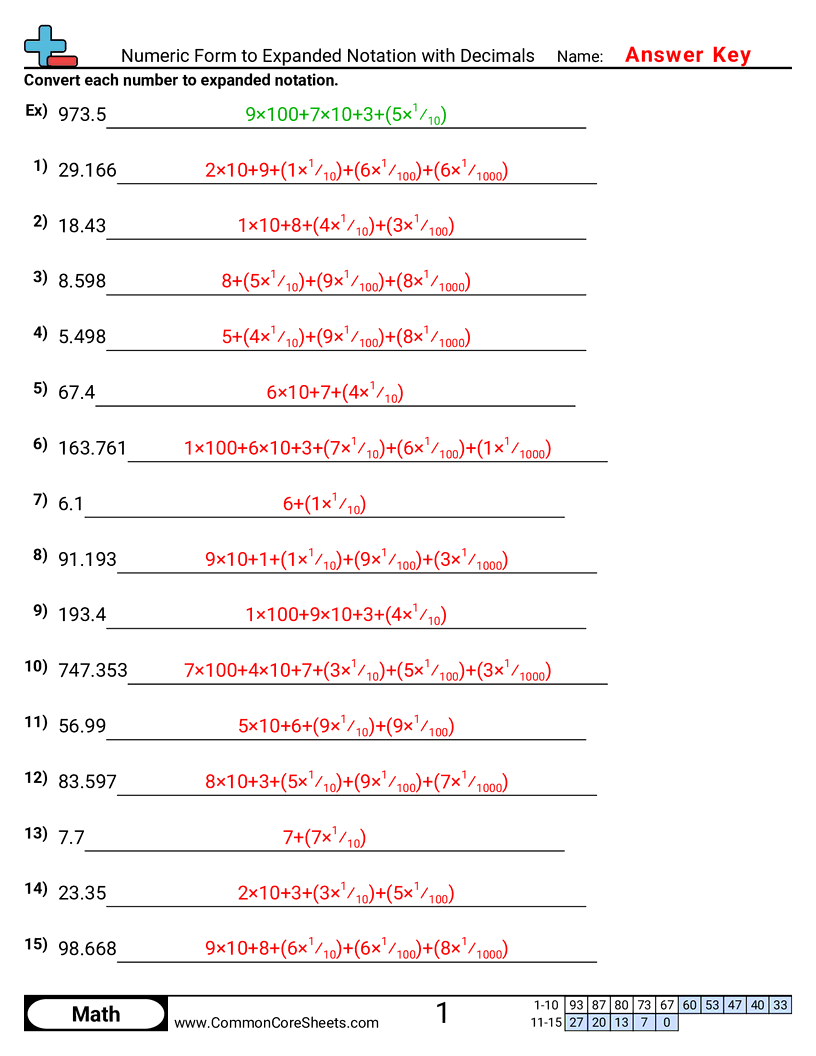
Break a decimal number into the value of each digit and write it as a sum. Match each digit to its correct place value, including tenths, hundredths, and thousandths. Use zeros as placeholders so the expanded notation still shows the correct value. Read a decimal number and explain what each part is worth in expanded form.
About these worksheets
These worksheets help students master scientific notation — a critical skill for working with very large and very small numbers. Activities include converting between scientific notation and standard form in both directions, as well as reading calculator e-notation. Aligned with eighth grade expressions and equations standards.
Convert numbers written in scientific notation back into standard form. Move the decimal the correct direction and count places to choose the right power of 10.
8ee4
Convert large or small numbers into scientific notation using a number between 1 and 10 times a power of 10. Move the decimal point the right number of places and write the matching exponent. Decide whether the exponent should be positive or negative based on whether the original number is greater than or less than 1. Rewrite scientific notation in a clean, normalized form with the coefficient in the correct range.
8ee4
Practice changing a number written in scientific notation into a regular decimal number. Use the exponent on 10 to decide how many places to move the decimal point. Write the final answer in standard form with the decimal in the correct place.
8ee4
Read calculator e-notation (like 3.2E5 or 3.2e-5) and say what it means. Convert numbers written in calculator scientific notation into standard form. Move the decimal the correct direction based on whether the exponent is positive or negative. Write the final answer as an ordinary decimal or whole number without exponents.
About these worksheets
Students practice converting between fractions, decimals, and percents using a variety of methods. Worksheets include visual models showing shaded amounts, direct conversion between any two forms, and working with repeating decimals. These resources build fluency with equivalent representations of rational numbers, spanning fourth through eighth grade standards.
4nf6
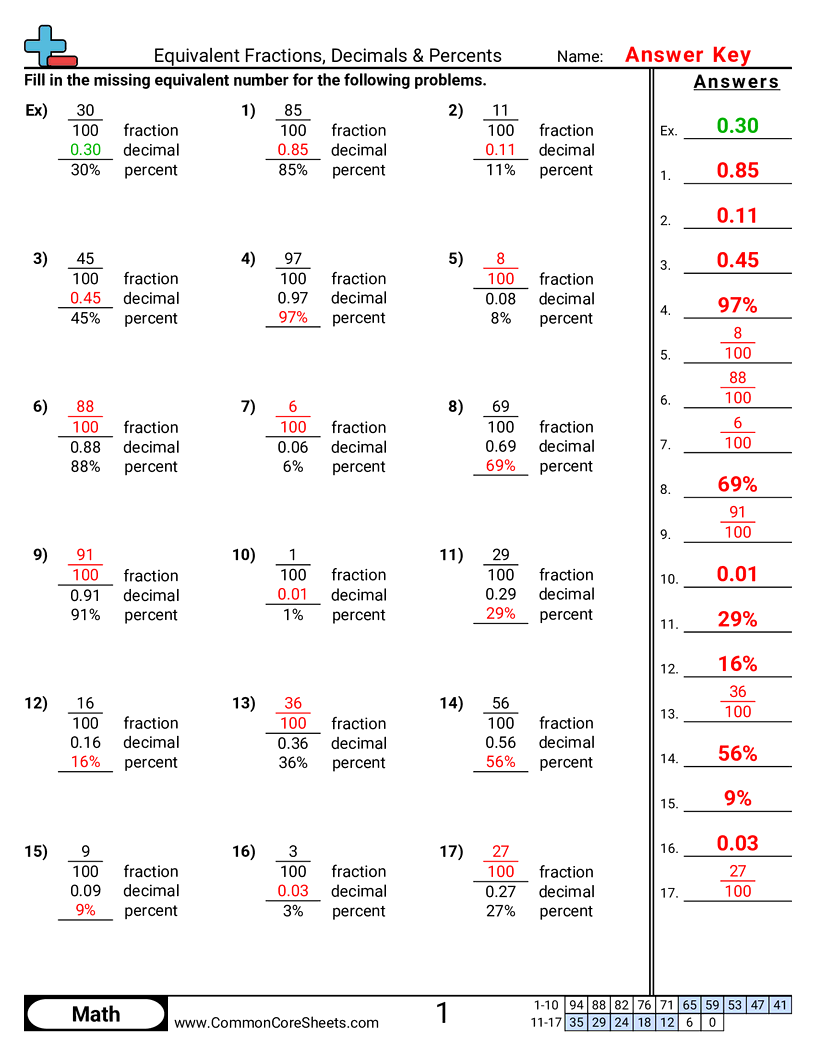
Convert between fractions, decimals, and percents that represent the same amount. Find a missing fraction, decimal, or percent by using equivalent values.
4nf6
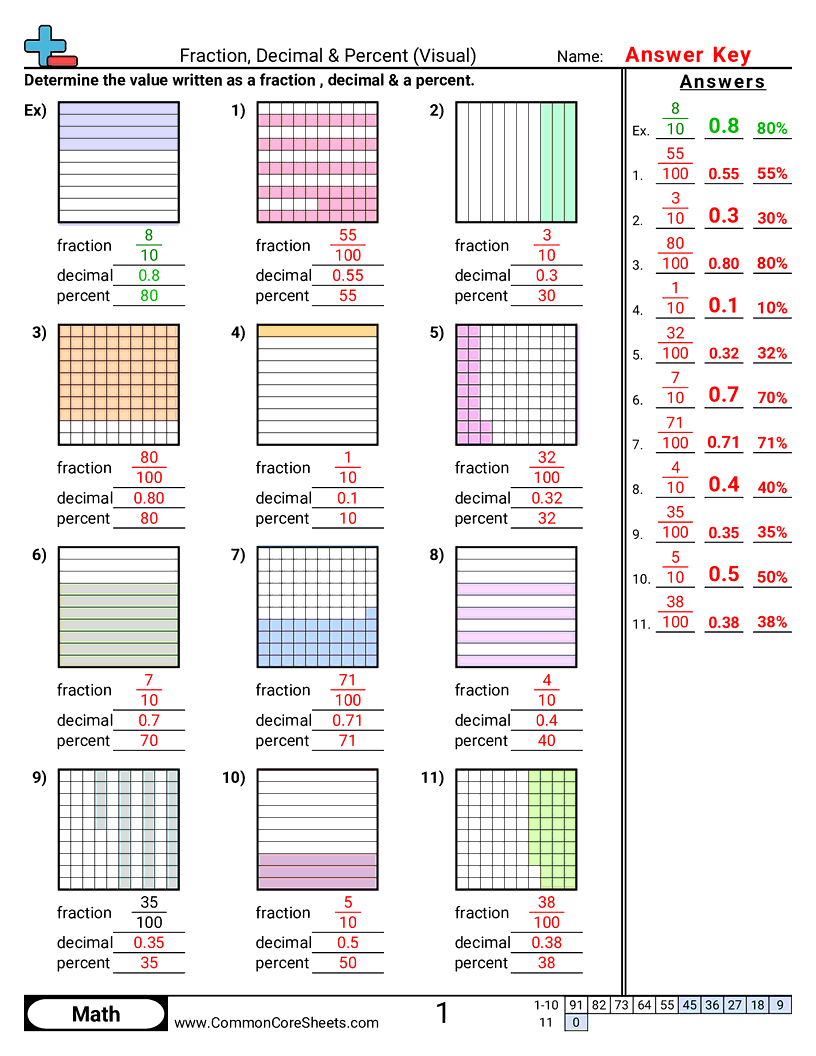
Read a shaded picture model and name the fraction that is shaded. Write the shaded amount as a decimal. Write the shaded amount as a percent. Convert between fraction, decimal, and percent to show the same amount in different ways.
4nf6
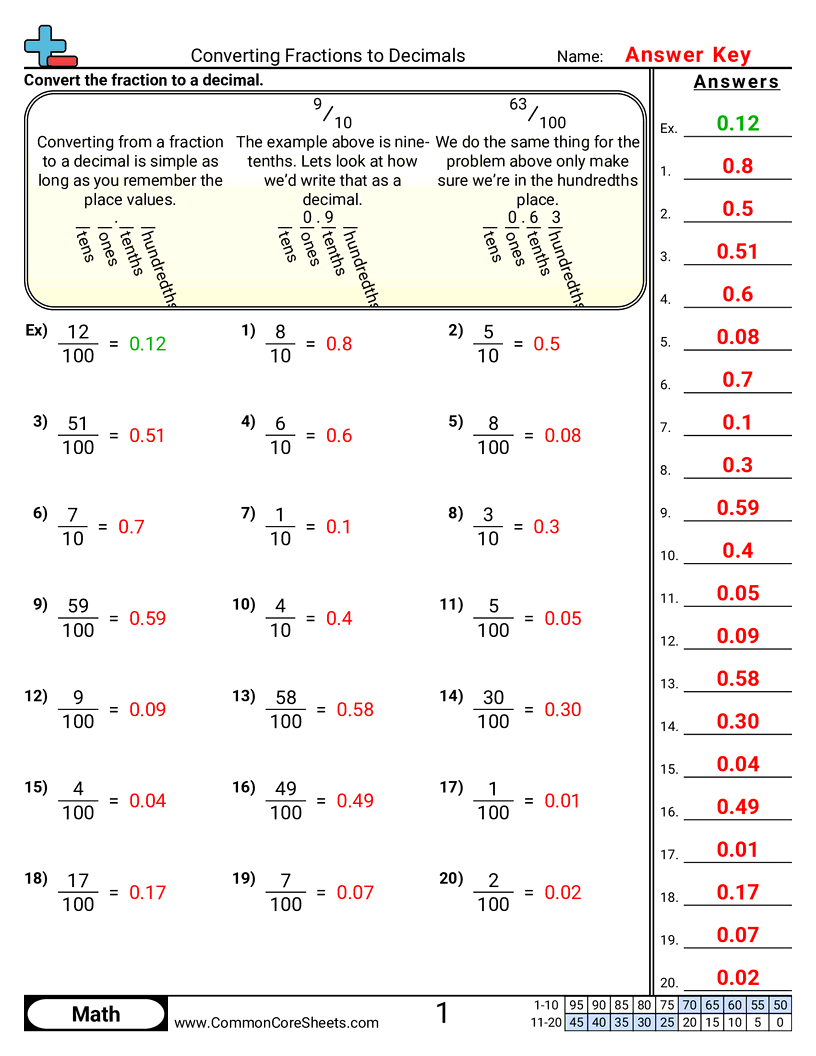
Turn a fraction into a decimal by dividing the numerator by the denominator. Write decimals correctly using tenths and hundredths place value.
4nf6
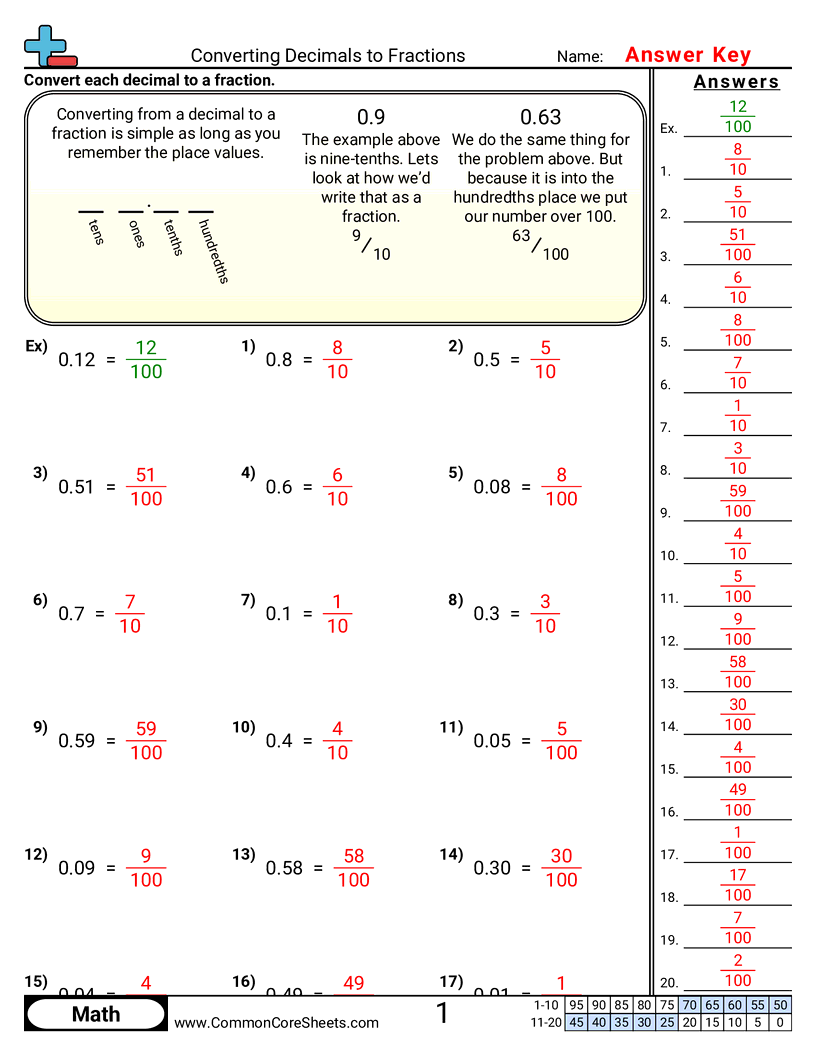
Turn a decimal into a fraction by using the place value to choose the denominator. Connect the decimal and fraction as two ways to show the same amount.
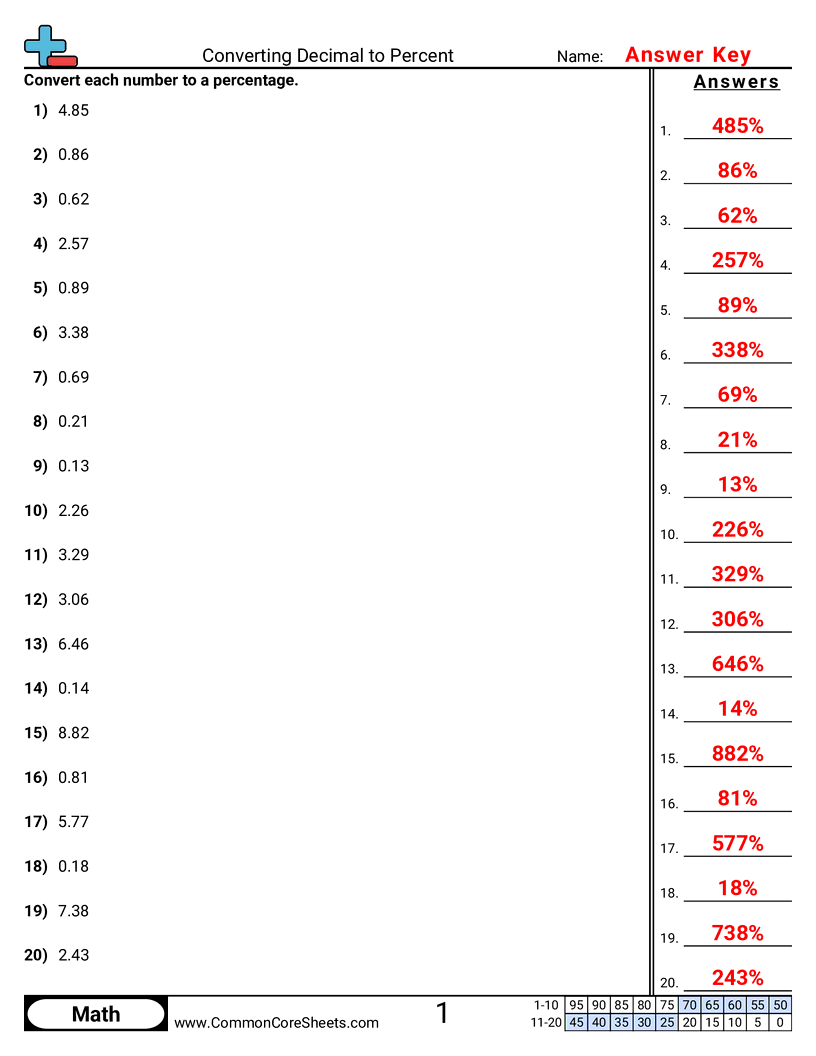
Turn a decimal into a percent by multiplying by 100. Move the decimal point two places to the right to write a percent. Write the final answer using the percent sign (%) correctly. Convert decimals that are less than 1, equal to 1, or greater than 1 into percents.
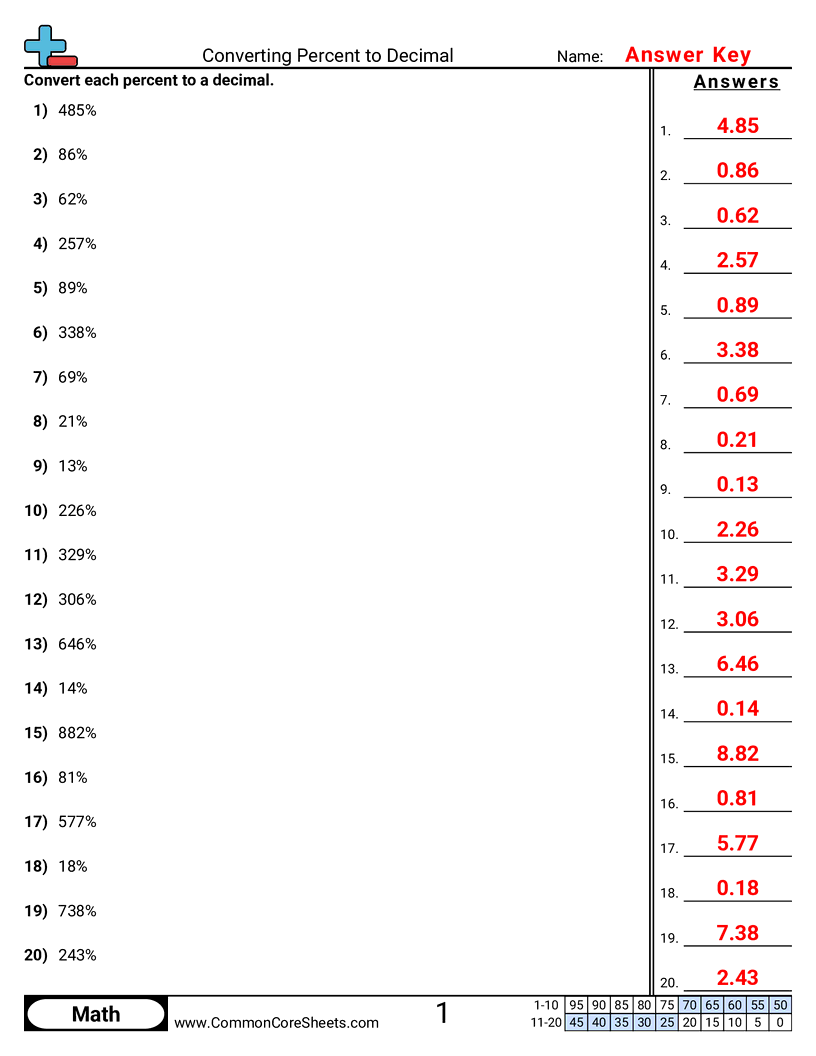
Convert a percent into a decimal by dividing by 100. Move the decimal point two places to the left to change a percent to a decimal. Write percents as decimals in standard decimal notation (like 0.25 instead of 25%).
8ns1
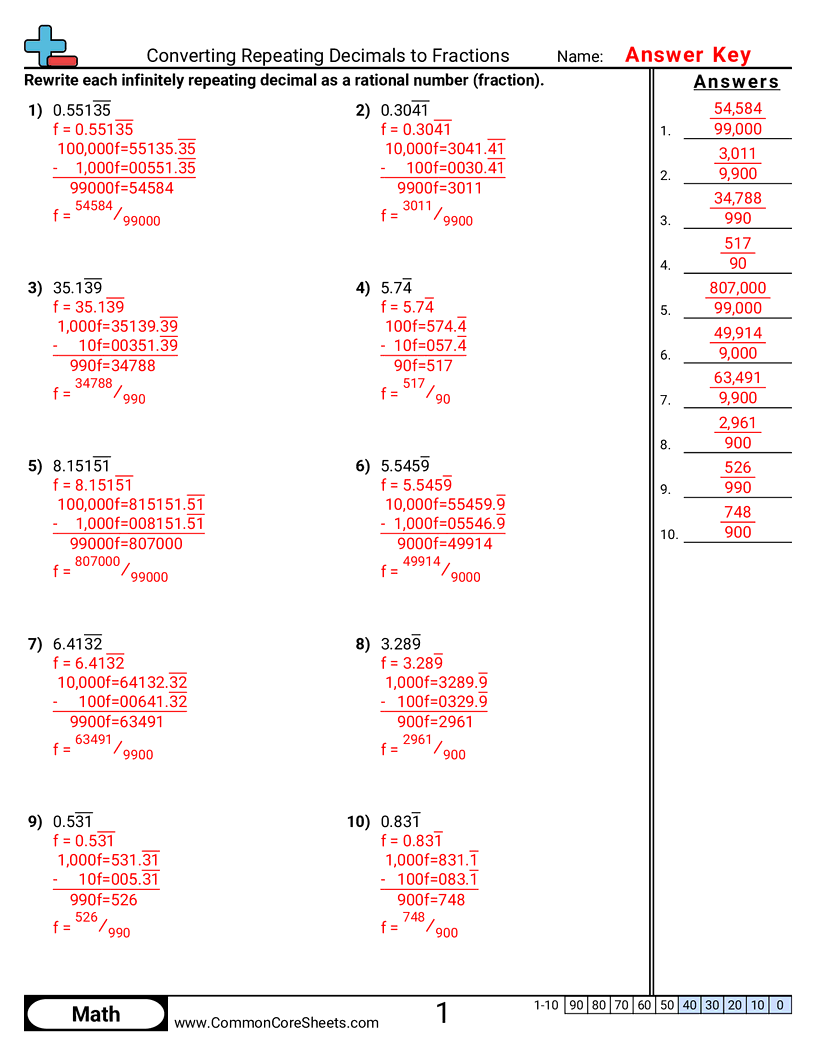
Recognize when a decimal repeats and identify the repeating part. Convert a repeating decimal into a fraction using an equation and solving for the value. Explain why repeating decimals represent rational numbers.
About these worksheets
These worksheets teach students to rewrite subtraction problems as addition problems by adding the opposite. This foundational skill for working with rational numbers helps students understand that subtracting a value is the same as adding its negative, building fluency with integer operations. Aligned with seventh grade number system standards.
7ns1c
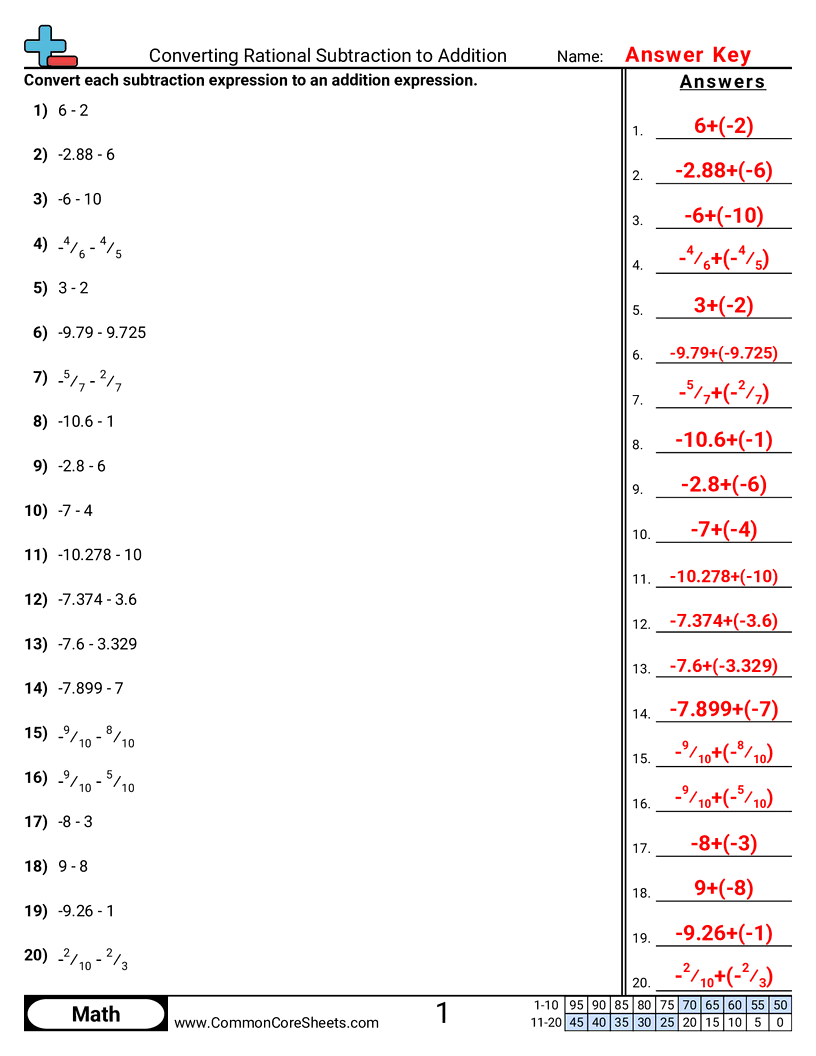
Rewrite a subtraction problem as an addition problem by adding the opposite number. Recognize that subtracting a number is the same as adding its negative (additive inverse). Work with positive and negative rational numbers written as fractions and decimals when rewriting expressions.
Playwire Advertisement