numbers Worksheets
Free algebra worksheets with answer key. No login or account needed. Below are a variety of topics from simplifying expressions or identifying coefficients to solving inequalities, graphing lines, and finding combinations. A grading column and quick grade scale maker grading a breeze and a modified pages help with lower level learners or when just introducing a topic. Great for teachers or for homeschool.
Browse Sheets By Problem Type
×
About these worksheets
These worksheets explore number concepts essential for middle school math, including square roots, cube roots, rational and irrational numbers, laws of exponents, scientific notation, radicals, and powers of ten. Students practice estimating radical values, simplifying expressions with exponents, and performing operations in scientific notation. Aligned with eighth grade Common Core standards, these resources build a strong number sense foundation for high school math.
8ns2
Recognize the perfect squares that are closest to a given square root. Decide which two whole numbers a square root falls between. Use nearby perfect squares to make a quick estimate of a square root’s size.
8ns1
Decide whether a number is rational or irrational. Recognize that fractions, integers, and whole numbers are rational because they can be written as a ratio of integers. Tell that terminating decimals and repeating decimals are rational numbers. Identify common irrational numbers like pi and square roots that do not simplify to a fraction.
8ns2
Decide which two whole numbers a square root falls between. Use nearby perfect squares to judge whether a square root is closer to the lower or higher whole number. Compare the sizes of different square roots by thinking about their values.
8ns2
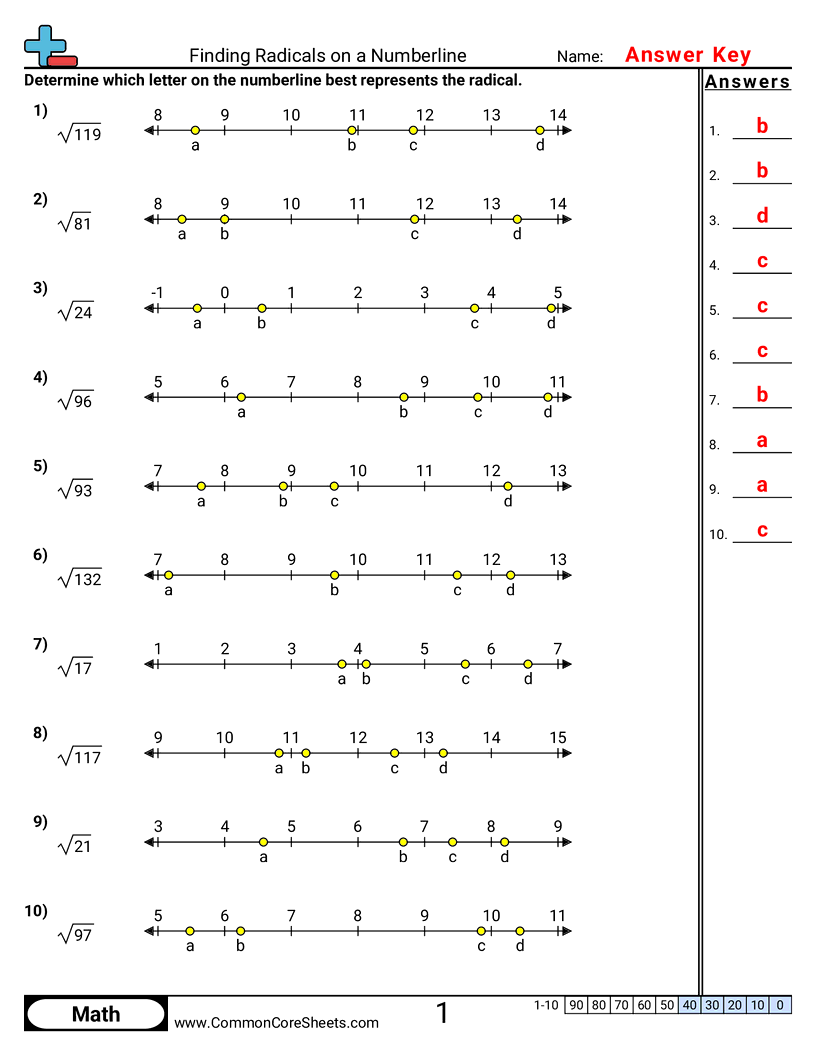
Place square roots on a number line by figuring out which two whole numbers they fall between. Estimate the decimal value of a square root well enough to plot it in the right spot. Use nearby perfect squares (like 16 and 25) to judge how close a square root is to a whole number.
8ee1
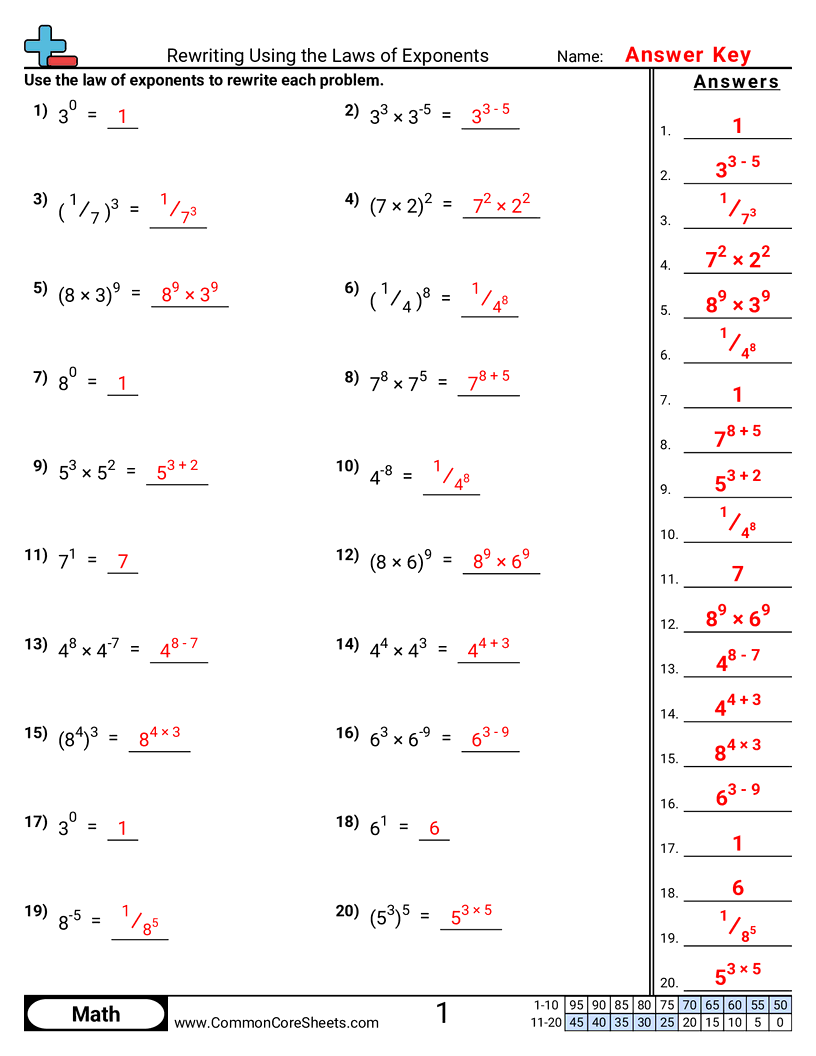
Rewrite expressions with exponents using the product and quotient rules. Simplify powers raised to powers by multiplying exponents. Rewrite expressions with zero and negative exponents using reciprocals.
8ee1
Practice rewriting negative exponents as fractions (e.g., 3⁻² becomes 1/3²) Multiply powers with the same base by adding their exponents, even when some exponents are negative Raise fractions to a power by applying the exponent to both the numerator and denominator Simplify expressions step by step to reach a final whole number or fraction
8ee2
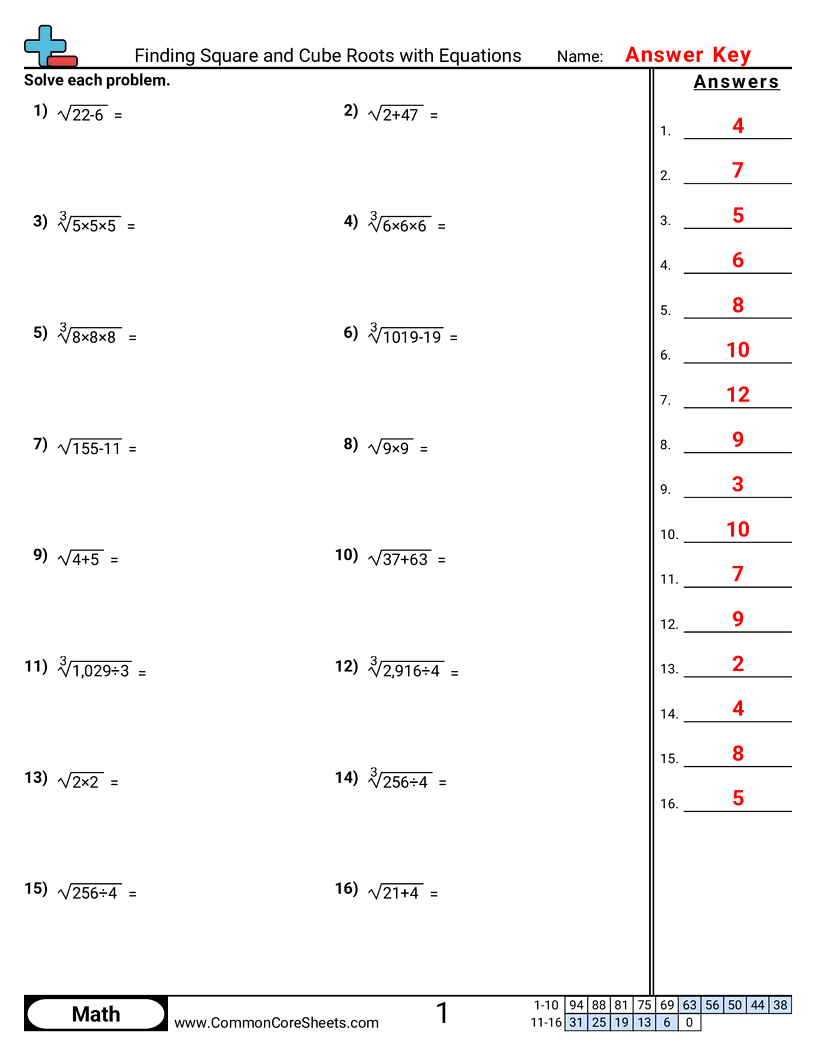
Evaluate expressions with squared and cubed numbers. Solve simple equations where a number is squared or cubed to find the missing value. Recognize perfect squares and perfect cubes and match them to their roots.
8ns2
Rewrite negative exponents as reciprocals so the exponent becomes positive. Evaluate expressions with negative powers to get the correct fraction or decimal value. Work with negative exponents on whole-number bases, fractions, and powers of 10.
8ns2
Recognize perfect squares and perfect cubes so you can solve quickly without a calculator.
8ns2
Break a number into factors and spot pairs that make a perfect square. Use exponents to write repeated factors more simply, like 3×3 as 3^2.
8ns2
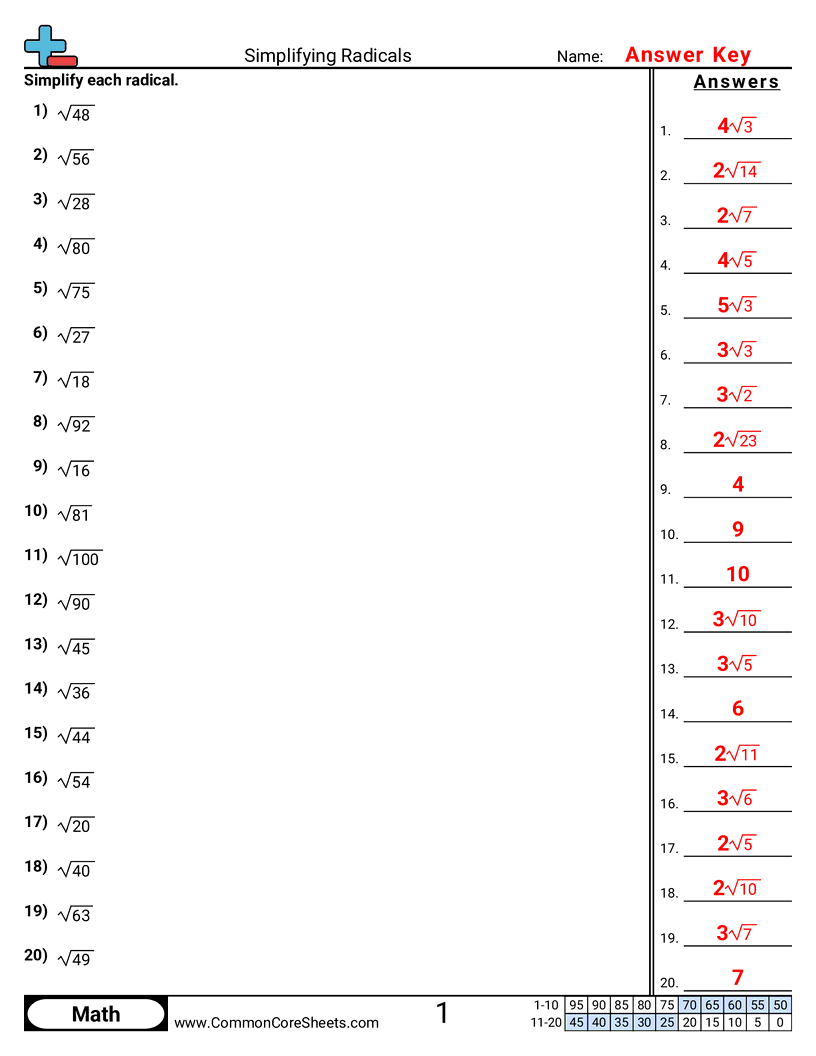
Practice rewriting square roots by pulling out perfect-square factors. Use factor pairs to break a number under a radical into simpler parts. Simplify radicals all the way to a number times a square root (like 3√2). Recognize which radicals are already in simplest form.
8ee3
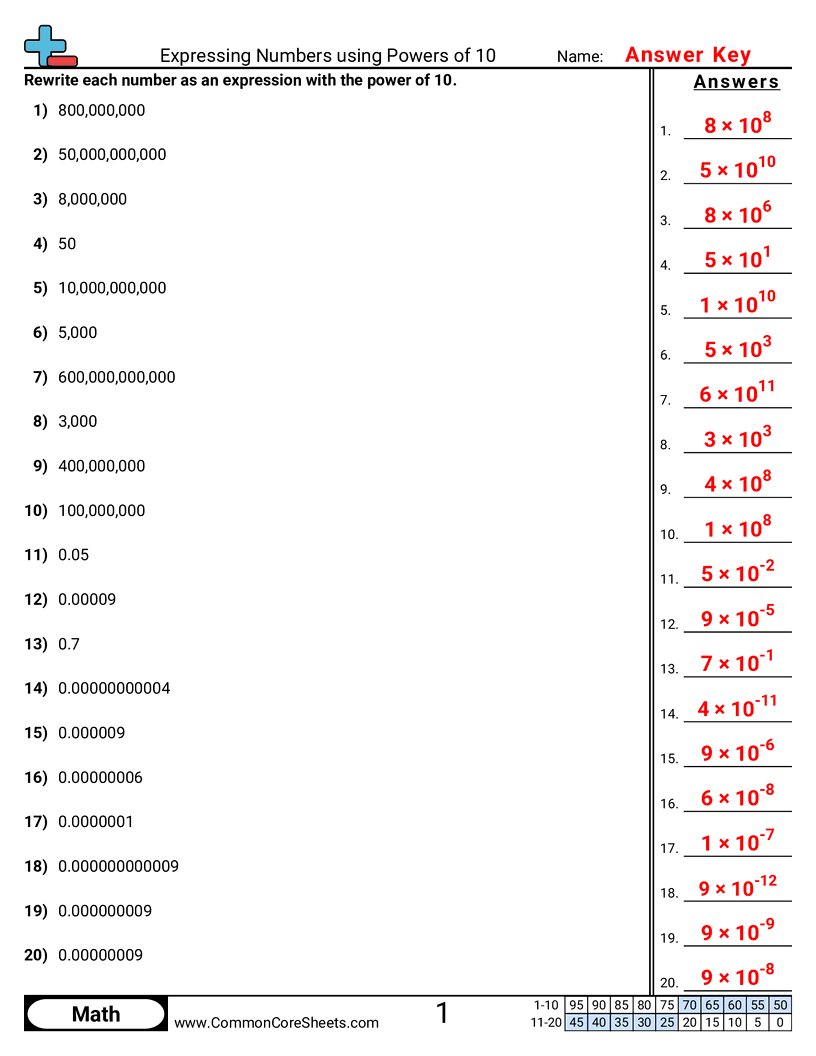
Rewrite whole numbers and decimals as one digit times a power of 10. Use place value to decide how many places the decimal point moves when converting. Work with both positive and negative exponents to show very large and very small numbers. Read and write numbers in a scientific-notation style and convert back to standard form.
8ee3
Compare two powers of ten and decide which one is larger or smaller. Figure out how many times bigger one power of ten is than another. Connect powers of ten to place value shifts, like moving the decimal left or right.
8ee4
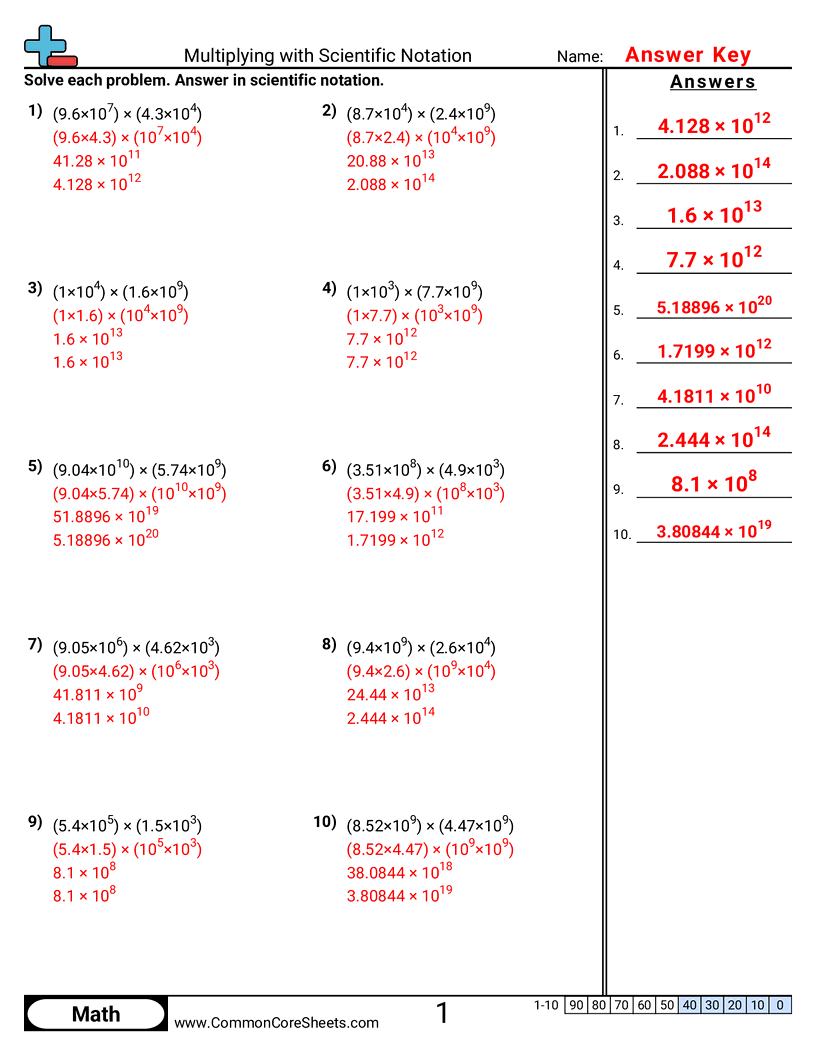
Multiply two numbers written in scientific notation. Multiply the coefficients and combine the powers of 10 using exponent rules. Rewrite answers in proper scientific notation by shifting the decimal and adjusting the exponent.
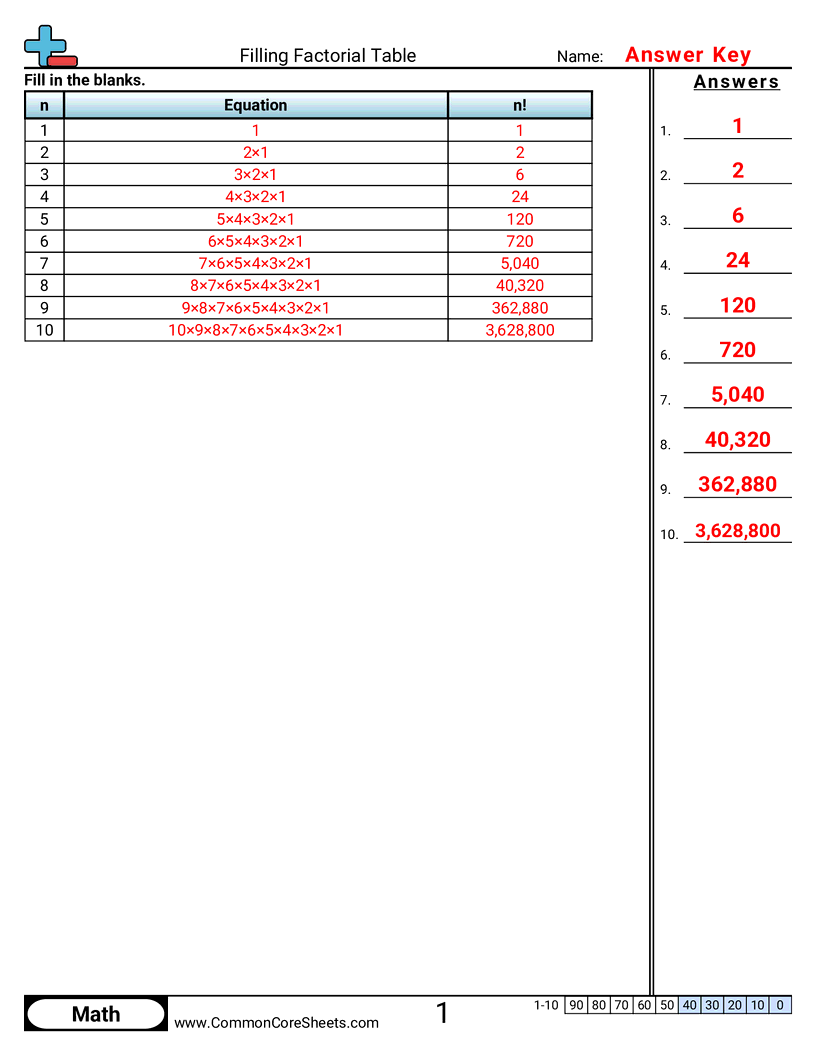
Understand what n! (factorial) means as multiplying whole numbers from 1 up to n. Fill in missing factorial values by continuing a multiplication pattern. Notice how factorials grow fast and compare which factorial is larger.
Advertisement