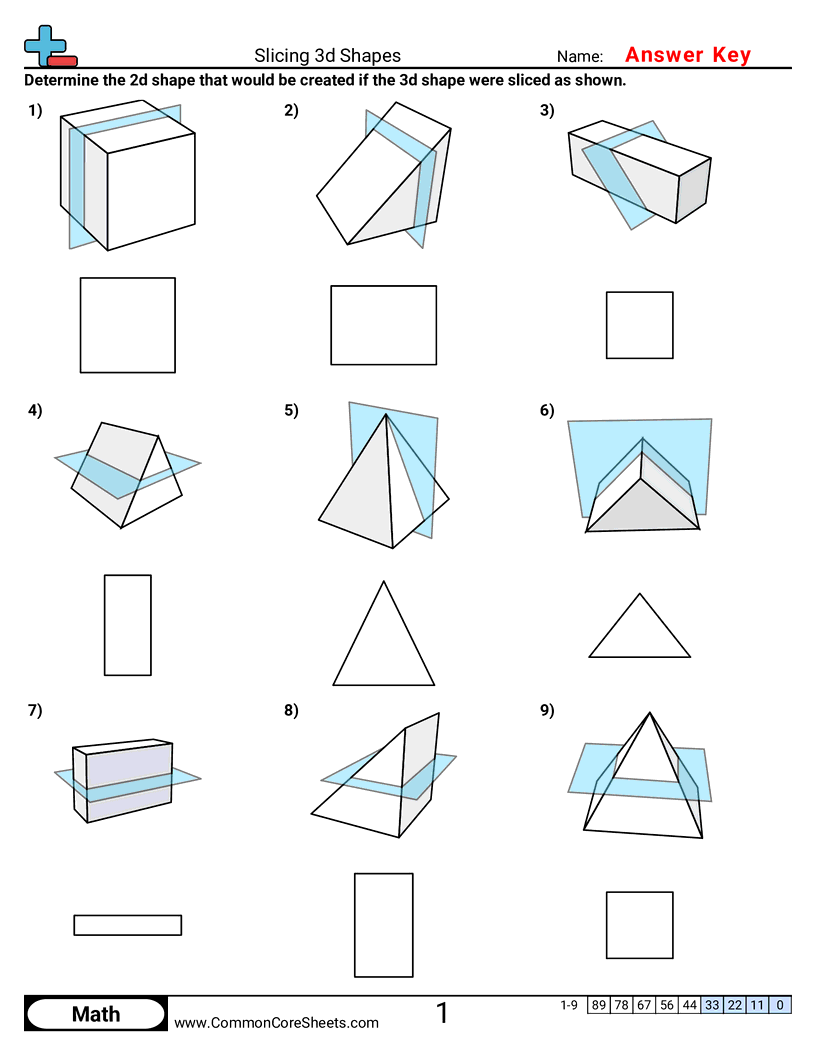
Practice essential 7th grade geometry skills with these free printable worksheets covering triangle properties, 3D shape cross-sections, and rectangle scaling. Students will determine valid triangles, identify 2D shapes from 3D slices, and create scaled rectangles to build spatial reasoning abilities.
Students explore the attributes and properties of both 2D and 3D shapes. Activities include counting faces, edges, and vertices of 3D shapes, determining whether given measurements can form a triangle, identifying cross-sections of sliced 3D shapes, drawing different perspectives of solids, classifying shapes by properties, evaluating true-or-false statements about shapes, and filling in attribute tables. Resources span fifth through seventh grade.
These worksheets introduce geometric transformations. Students practice drawing scaled rectangles using scale factors, identifying whether a shape has been translated (slid), rotated (turned), or reflected (flipped), and determining whether pairs of shapes are similar, congruent, or neither. Aligned with seventh grade geometry.